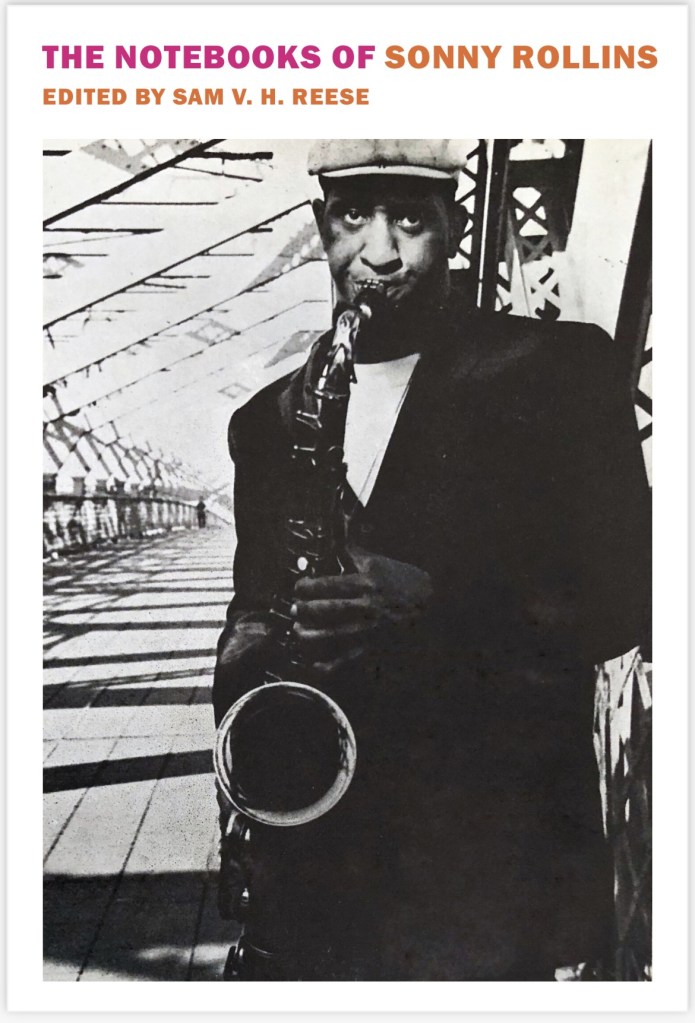
Sonny Rollins is one of the towering masters of American music, a virtuoso of the saxophone and an unequaled improviser whose live performances are legendary and who reshaped modern jazz time and time again over the course of a career lasting more than sixty years. Throughout the greater part of it, Rollins also maintained a notebook in which he sketched in words and images as he pondered art and life and his own search for meaning. The Notebooks of Sonny Rollins brings together these notebooks for the first time, offering an unequaled glimpse into the mind and workshop of a musical titan, and his personal responses to vital questions of art, health, and how a person should be.
In the fall of 1959, Rollins famously took a break from performing and recording. He turned to practicing for long hours, sometimes deep into the night, on the Williamsburg Bridge, and it was then for the first time that he began to turn regularly to his notebooks, which at the time and in the years to come proved for him an indispensable instrument of change in their own right. Here Rollins can tend towards the aphoristic, as in “Face the startling and intriguing reality that there is within me a force working hard for my own destruction, even as I try to improve.” Elsewhere, music is front and center, as he mingles observations on embouchure, fingering, and technique with reflections on harmony and dissonance.
Lists of daily chores, rehearsal routines, reflections on particular tours and recordings (including detailed notes on how Rollins wanted live albums to be edited), and a steady stream of notes on diet and health also find their way into the notebooks, as do ruminations on systemic racism and the way nightclub culture degrades jazz musicians. Rollins emphatically resists claims that jazz should be considered solely as an African American art form, protesting the diminishment that is caused to jazz musicians by labeling their work “racial music.” “The point to be absorbed here,” he writes, “is that any definition which seeks to separate Johann Sebastian Bach from Miles Davis is defeating its own purpose of clarification. The musings of Miles is then the bouncing of Bach both played against each other.”
I carefully selected and edited the notebooks, working with Sonny to ensure that the collection represents his development as a musician and thinker. I open with an introduction that traces the development of Sonny’s writing over his career, and highlights some of the most interesting threads running through this unique body of writing.
The Notebooks of Sonny Rollins can be ordered through NYRB (US) and Penguin (UK)
 SAM REESE